

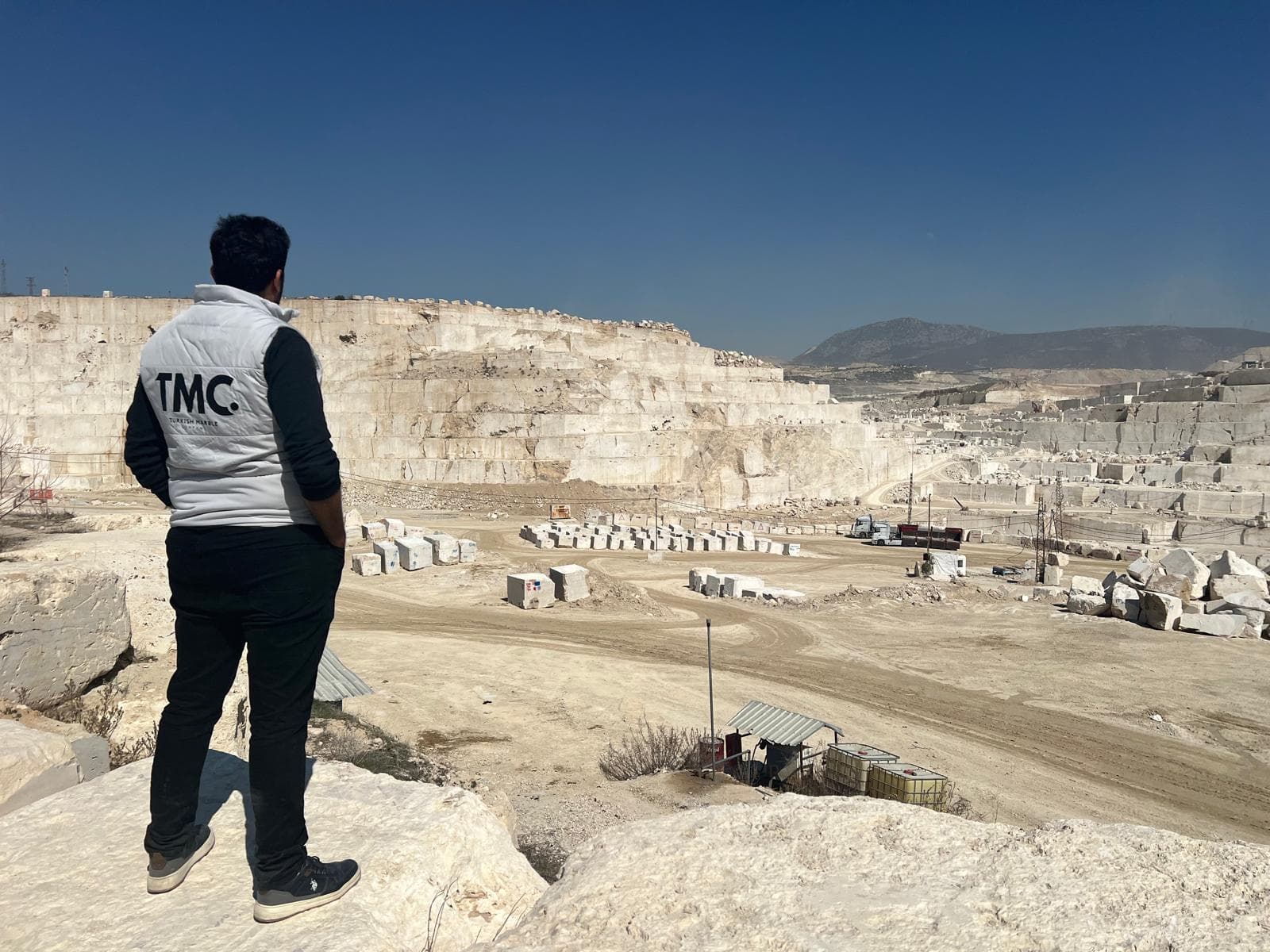
The first time I watched a 20-ton block being cut, I did not know what I was looking at. I was twenty-three years old. I had read about quarrying. I had seen photographs. I had even handled enough stone to recognize a good block by its weight and ring. But standing at the quarry face as the diamond wire sliced through solid rock was a different thing entirely.
The wire moves at about 25 meters per second. It carries industrial-grade diamond beads strung on a steel cable. It is lubricated by a constant stream of water, which turns the dust into a milky slurry that runs down the rock face like a slow river. The sound is not loud in the way you expect. It is a deep, grinding hum that you feel in your chest before you hear it with your ears.
What struck me first was the patience. The wire takes hours to cut through a single face. Hours. You cannot rush it. If you pull too hard, the wire snaps and you lose a day. If you let it sag, the cut wanders and the block is wasted. So you stand there, watching the wire disappear into the rock millimeter by millimeter, and you learn something that no textbook will ever teach you: the stone tells you when it is ready.
There is a moment, about halfway through the cut, when the tension in the wire changes. It becomes a fraction less strained. The hum shifts an octave. The experienced operators feel it before they hear it. They adjust the tension slightly, ease the feed, and let the wire finish its work at its own pace. If a man has never done this before, he will not notice the change. He will keep the feed constant, the wire will bind, and he will lose the block.
The moment the cut completes, the block shifts. There is a sound like a deep crack — not loud, but unmistakable. The block settles a few millimeters away from the quarry face, and suddenly what was part of a mountain becomes a discrete object. It is like watching a birth. I do not use that word lightly. I have now seen this happen hundreds of times, and it still affects me the same way.
Then the block is lifted. This is where most people get it wrong. They think the skill is in the cutting. It is not. The skill is in reading the block before it is even detached. An experienced quarry master looks at a raw, uncut rock face and sees lines that no one else sees — natural fracture planes, stress lines, zones of softer material that will never polish to a uniform finish. He marks the block boundaries with chalk, and the wire follows his marks. The machine does the cutting. The man does the seeing.
I have watched blocks that looked perfect from the outside reveal internal cracks the moment they were lifted. I have watched blocks that looked mediocre produce the most stunning slabs I have ever seen. You never know until the block is cut open. That is the gamble, and it is why premium stone costs what it costs. You are not paying for the material. You are paying for the quarry master’s ability to reduce the gamble from a coin flip to a calculated bet.
The best analogy I can give is buying a whole watermelon. You can tap it, weigh it, check the color of the spot where it rested on the ground. But you will not know if it is perfect until you cut it open. A quarry block is a watermelon that weighs twenty tons and has been ripening underground for two hundred million years.
Every time I visit a quarry, I stand at the cut face for a few minutes and watch the wire work. It reminds me that stone is the only building material that is exactly as old as it looks. Steel is manufactured. Concrete is poured. Brick is fired. But stone was formed by forces that have been operating since the planet began, and when we extract it, we are not creating something new. We are revealing something that was already there, waiting.
That is worth standing still for.