

Turkey is one of the world's largest natural-stone exporters, and for good reason: it sits on vast reserves of marble, travertine, limestone and onyx, and its quarries and factories can load a container to almost any port on earth. For a first-time buyer, though, the stone is the easy part. It is the shipping terms, the paperwork and the question of who pays for what that turn an exciting project into an anxious one. This guide walks through the whole journey in plain English.
The shape of a stone shipment
Natural stone travels in three main forms, and which one you buy changes how it is packed and priced. Blocks are raw quarry cubes weighing 15 to 25 tonnes, shipped on flat-racks for buyers who will saw them themselves. Slabs are large polished sheets, loaded upright in steel or timber A-frame bundles inside a container. Tiles and cut-to-size pieces are crated flat on pallets. A standard 20-foot container carries roughly 20 to 22 tonnes of stone — in practice about 18 to 20 slabs, or 400 to 500 square metres of tiles — and it is weight, not volume, that usually fills it first.
Incoterms: who pays, and where the risk passes
Every international quote is written against an Incoterm — a three-letter code from the International Chamber of Commerce that defines exactly where the seller's responsibility ends and yours begins. It answers two questions at once: up to which point does the seller pay the cost, and at which point does the risk of damage or loss pass to you. Four terms cover almost all stone trade, and they form a ladder from the buyer carrying everything to the seller carrying almost everything.
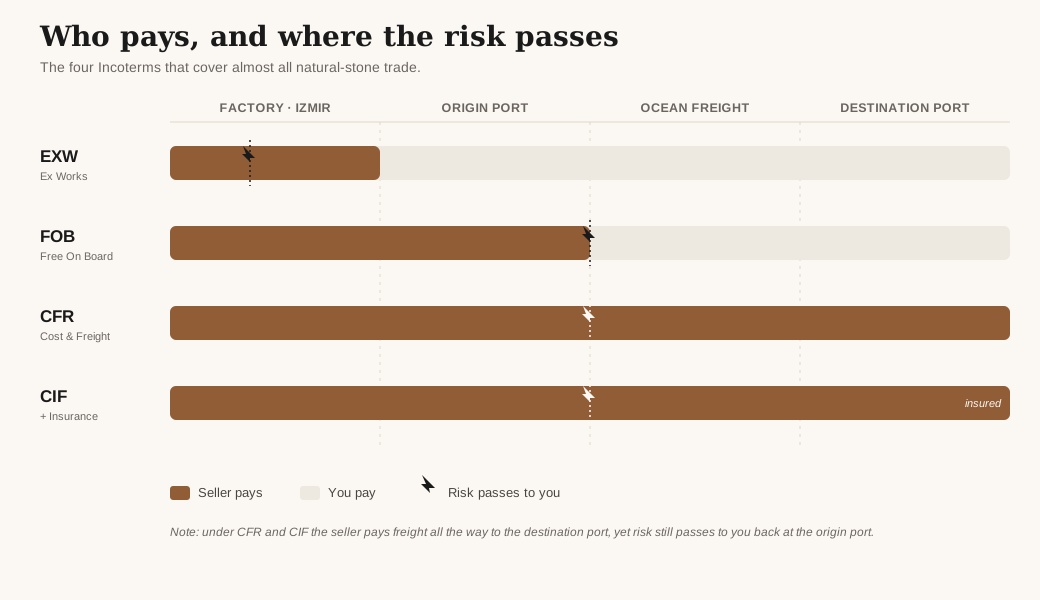
EXW (Ex Works) is the barest quote. The price covers the stone sitting on the ground at the factory in Izmir, and nothing else. From that moment, loading, inland trucking, export clearance, port charges, ocean freight and insurance are all yours to arrange and pay. EXW looks cheapest on paper precisely because it includes the least — a genuine trap for first-time buyers comparing headline numbers.
FOB (Free On Board) is the workhorse of the trade. The seller delivers the stone loaded onto the vessel at the Turkish port, cleared for export, and pays every cost up to that point. Risk passes to you once the goods are on board, so from the origin port onward the ocean freight and insurance are yours. FOB is popular because it draws a clean line at the port and lets you use your own freight forwarder. Strictly, the ICC now recommends FCA for containerised cargo, since your box is handed over at the terminal rather than lowered onto a ship — but FOB remains the industry norm and most Turkish exporters quote it.
CFR (Cost and Freight) adds the ocean freight to FOB: the seller pays to get the container to your destination port. Risk still passes to you back at the origin port, so if something happens at sea it is your claim to make — which is exactly why the next term exists.
CIF (Cost, Insurance and Freight) is CFR plus a marine insurance policy the seller buys on your behalf, covering the goods to the destination port. It is the most hands-off term for a buyer who simply wants the container to arrive at their local port with the sea leg handled. One caution: the seller's default CIF insurance is minimum cover, so for high-value polished slabs, ask for higher all-risks cover or arrange your own.
One more term is worth knowing. DAP (Delivered At Place) means the seller delivers all the way to your yard or site, and only the import duties and taxes are left to you — the simplest arrangement for a buyer, and the highest headline price. DDP goes one step further and includes those duties too, but few stone exporters offer it, because foreign tax rules are hard to price accurately.
A worked example
Say you are buying one container of Denizli travertine. Under EXW you might see the lowest sticker price, but you then pay a Turkish forwarder for loading and haulage to Izmir port, export documentation, terminal handling, the ocean freight to your port, and insurance — easily adding 20 to 35 percent to that EXW figure by the time the box is at sea. Under FOB, all the Turkish-side costs are already in the price and you add only freight and insurance. Under CIF, you add almost nothing until the container lands at your port. The stone is identical; only the line where responsibility passes has moved. Always compare quotes on the same Incoterm, or you are not comparing like with like.
The documents you will actually handle
A stone import generates a predictable stack of paperwork, and a good supplier prepares most of it for you. The proforma invoice comes first — it is the formal offer that lists the stones, quantities, unit prices, the Incoterm and the payment terms, and it is what you use to arrange payment or a letter of credit. On shipment you receive the commercial invoice and a packing list with bundle-by-bundle weights and dimensions, the bill of lading from the shipping line (your title to the goods), and a certificate of origin. Buyers in the EU should specifically ask for an A.TR movement certificate: under the EU–Turkey customs union it lets most stone clear with zero import duty, which can be a substantial saving.
If your stone is going into a building in the European Economic Area, there is one more requirement people forget: natural stone sold as a construction product usually needs CE marking and a Declaration of Performance under the relevant harmonised standard — EN 1469 for wall cladding, EN 12058 for flooring slabs, EN 12057 for modular tiles. Reputable Turkish exporters can supply this. Confirm it before you order rather than at the border.
What the stone really costs to land
The price per square metre is only the beginning of your landed cost. Budget for inland haulage from quarry to port, origin terminal handling, ocean freight, marine insurance, destination terminal handling, a customs broker's fee, any import duty (often zero for the EU via the A.TR certificate, but check your own tariff), and local VAT or sales tax, which is usually recoverable for a business but still has to be financed. A useful habit: ask your supplier for an FOB or CIF quote, then add your own destination-side costs to reach a true landed figure before you commit.
Paying safely
The established rhythm in the stone trade is a deposit to start production and the balance before the container sails. A 30 percent deposit with 70 percent against shipping documents is common and fair — it protects you, because the bulk of your money is held until the goods are demonstrably on their way, and it protects the supplier, who is not cutting expensive slabs to your order on a promise. For a first order with a new supplier, paying the balance against a copy of the bill of lading, or through a letter of credit, adds a further layer of safety.
How we make this easier
At DIJA we quote every order on a clear Incoterm and generate a full proforma invoice that spells out the stones, formats, finishes, the incoterm cost breakdown and the payment schedule — the same document your bank and customs broker will ask for. If you are importing Turkish marble or travertine for the first time, tell us your destination port and whether you would prefer an EXW, FOB or CIF basis, and we will build the numbers around it so there are no surprises at the border. The stone is the part you fell in love with; the logistics are the part we do every day.